Handwritten Font Bundle: A Strategic Asset for Authentic Brand Communication
In an era dominated by digital precision and algorithmic content, the human touch has become a premium commodity. For entrepreneurs, educators, freelancers, and small business owners, establishing a genuine connection with an audience often hinges on perceived authenticity. This is where the Handwritten Font Bundle emerges not merely as a collection of decorative typefaces, but as a strategic tool for communication. By integrating these fonts into your visual identity, you can bridge the gap between corporate efficiency and personal warmth, enhancing everything from daily note-taking to high-stakes brand positioning.
The Psychology of Handwriting in Modern Design
Before diving into the specific features of this bundle, it is essential to understand why handwritten typography resonates so deeply with adults aged 20–50. Psychological studies in marketing suggest that handwritten elements trigger associations with effort, care, and individuality. Unlike rigid sans-serif or serif fonts, which convey stability and tradition, script and handwriting fonts communicate approachability and creativity.
For decision-makers, this distinction is critical. When designing a greeting card, a product label, or a social media graphic, the choice of font signals intent. Using the Handwritten Font Bundle allows you to inject personality into static designs without requiring professional calligraphy skills. It enables small business owners to maintain a consistent brand voice that feels curated yet accessible, fostering trust and loyalty among customers who value artisanal quality over mass-produced uniformity.
Strategic Versatility Across Industries
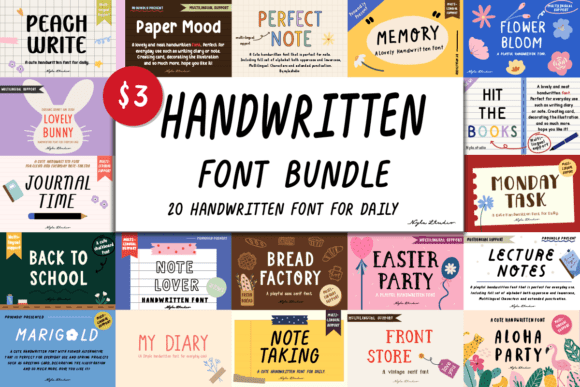
The true value of the Handwritten Font Bundle lies in its diversity. The inclusion of twenty distinct styles—from the playful "PeachWrite" and "Lovely Bunny" to the structured "Hit the Books" and "Lecture Notes"—means that users are not limited to a single aesthetic. Instead, they can select typefaces that align precisely with their specific goals and contexts.
Branding and Packaging
For entrepreneurs launching consumer goods, packaging is the first point of physical contact with the customer. Fonts like "Bread Factory" or "Front Store" evoke nostalgia and craftsmanship, ideal for organic food brands, boutique bakeries, or handmade crafts. These fonts suggest that a real person was involved in the creation process, countering the sterility of industrial manufacturing. Similarly, "Flower bloom" and "Marigold" offer soft, organic curves perfect for beauty products, wellness journals, or floral arrangements, reinforcing themes of growth and natural beauty.
Education and Content Creation
Educators and bloggers face the challenge of keeping material engaging without sacrificing readability. The Handwritten Font Bundle provides specialized options for this niche. "Monday task," "Back to school," and "Journal time" are particularly effective for creating study guides, classroom posters, or educational worksheets. These fonts mimic the look of teacher’s notes, making complex information feel more manageable and less intimidating. For bloggers, using these fonts for pull quotes or headers can break up text-heavy articles, improving user experience and encouraging longer reading sessions.
Personal Productivity and Planning
On an operational level, the utility of this bundle extends beyond public-facing design. Professionals who rely on digital planning tools can use fonts like "Note taking," "Perfect note," and "Memory" to create personalized templates for diaries, meeting agendas, and project trackers. While these may not be intended for public distribution, using aesthetically pleasing fonts for internal documents can enhance mental engagement and make routine tasks feel more rewarding. This subtle shift in environment can lead to improved productivity and a greater sense of ownership over one’s workflow.
Technical Features That Support Professional Workflows
A common misconception is that handwritten fonts lack the technical robustness required for professional projects. However, the specifications of the Handwritten Font Bundle demonstrate a commitment to usability and accessibility. Understanding these features is vital for designers and developers who need to ensure their work renders correctly across different platforms.
- Extended Punctuation and Multilingual Support: Most fonts in the bundle include extended punctuation and numeral accents, supporting multilingual characters. This is crucial for global businesses targeting diverse audiences. Whether you are localizing a campaign for European markets or simply adding special symbols to a logo, the comprehensive character sets reduce the need for workarounds or external fixes.
- Stylistic Sets: The availability of stylistic sets allows for nuanced customization. Users can toggle between different ligatures or alternate glyphs to fine-tune the look of a headline. This feature adds depth to the design process, enabling creators to achieve a unique typographic signature rather than relying on default settings.
- Format Compatibility (TTF/OTF): With both TrueType Format (TTF) and OpenType Format (OTF) files included, the bundle ensures compatibility with a wide range of software, from Adobe Creative Cloud to Canva and Microsoft Office. This flexibility is essential for freelancers and agencies that collaborate with clients using different operating systems or design preferences.
Note that while most fonts offer extensive language support, exceptions exist, such as "My diary," which may have limited character sets. Careful review of individual font documentation is recommended to avoid unexpected rendering issues in international projects.
Decision-Making: When to Use and When to Avoid
Adopting the Handwritten Font Bundle requires strategic restraint. Misuse of handwriting fonts can lead to cluttered designs, reduced readability, and a perception of unprofessionalism. To maximize impact, consider the following guidelines:
- Limit Usage to Headlines and Accents: Handwritten fonts are generally difficult to read in long paragraphs. Reserve them for titles, logos, short slogans, or decorative elements. Use clean, legible sans-serif or serif fonts for body text to ensure clarity.
- Maintain Brand Consistency: Do not mix too many handwriting styles within a single project. Select one or two fonts that complement each other and align with your brand identity. For example, pairing "Aloha party" with "Easter party" might create a cohesive festive theme, whereas mixing "Black clover" with "Lovely bunny" could result in visual dissonance.
- Consider the Context: Evaluate the emotional tone you wish to convey. "Black clover" suggests mystery or sophistication, suitable for evening events or luxury goods. In contrast, "PeachWrite" conveys sweetness and friendliness, better suited for children’s products or casual lifestyle brands. Aligning font choice with contextual expectations enhances message delivery.
Risks of Unintentional Application
Without clear goals, the ease of access to these fonts can lead to overuse. Relying on handwriting fonts as a crutch for weak design concepts can dilute brand authority. If a company aims to project technological innovation or financial security, a whimsical font like "Hit the books" may undermine credibility. Strategic decision-making involves recognizing when a handwritten aesthetic is appropriate and when a more formal typeface is necessary.
Furthermore, legal considerations remain paramount. While the bundle offers significant savings—priced at just $3 compared to the original value of $249—users must still adhere to licensing terms. Ensure that your intended use (personal, commercial, or extended commercial) is covered by the license to avoid potential disputes. Proper attribution, if required, should also be integrated seamlessly into the design.
Long-Term Value and Creative Growth
Investing in the Handwritten Font Bundle is an investment in creative versatility. For hobbyists and professionals alike, having a diverse library of high-quality handwritten fonts reduces friction in the design process. It eliminates the need to search for new assets for every new project, allowing for faster iteration and experimentation.
Moreover, mastering the use of these fonts builds a skill set that translates across mediums. As you learn to balance handwritten elements with structured layouts, you develop a keen eye for typography and hierarchy. This skill enhances not only graphic design but also presentation decks, email newsletters, and social media content, contributing to a more polished and cohesive professional presence.
In conclusion, the Handwritten Font Bundle is more than a cost-effective acquisition; it is a toolkit for humanizing digital communication. By strategically selecting fonts like "Paper mood," "Note lover," or "Journal time," you can elevate everyday materials into memorable experiences. Approach this resource with intention, respect for readability, and alignment with your broader goals, and it will serve as a powerful asset in achieving better results in branding, education, and personal expression.